The Mob Won. Blender Lost
I was not going to write this post. Putting myself in the middle of community controversies (especially one I'm no longer part of) is not something I do, and this one has been loud enough without my contribution. But Blender was a significant part of my professional life for more than 10 years. I was a gold member of the Development Fund and donated for several years. That gives me some standing to say what I think, probably more than most people who flooded the comments demanding the Foundation to change course.
So here it is.
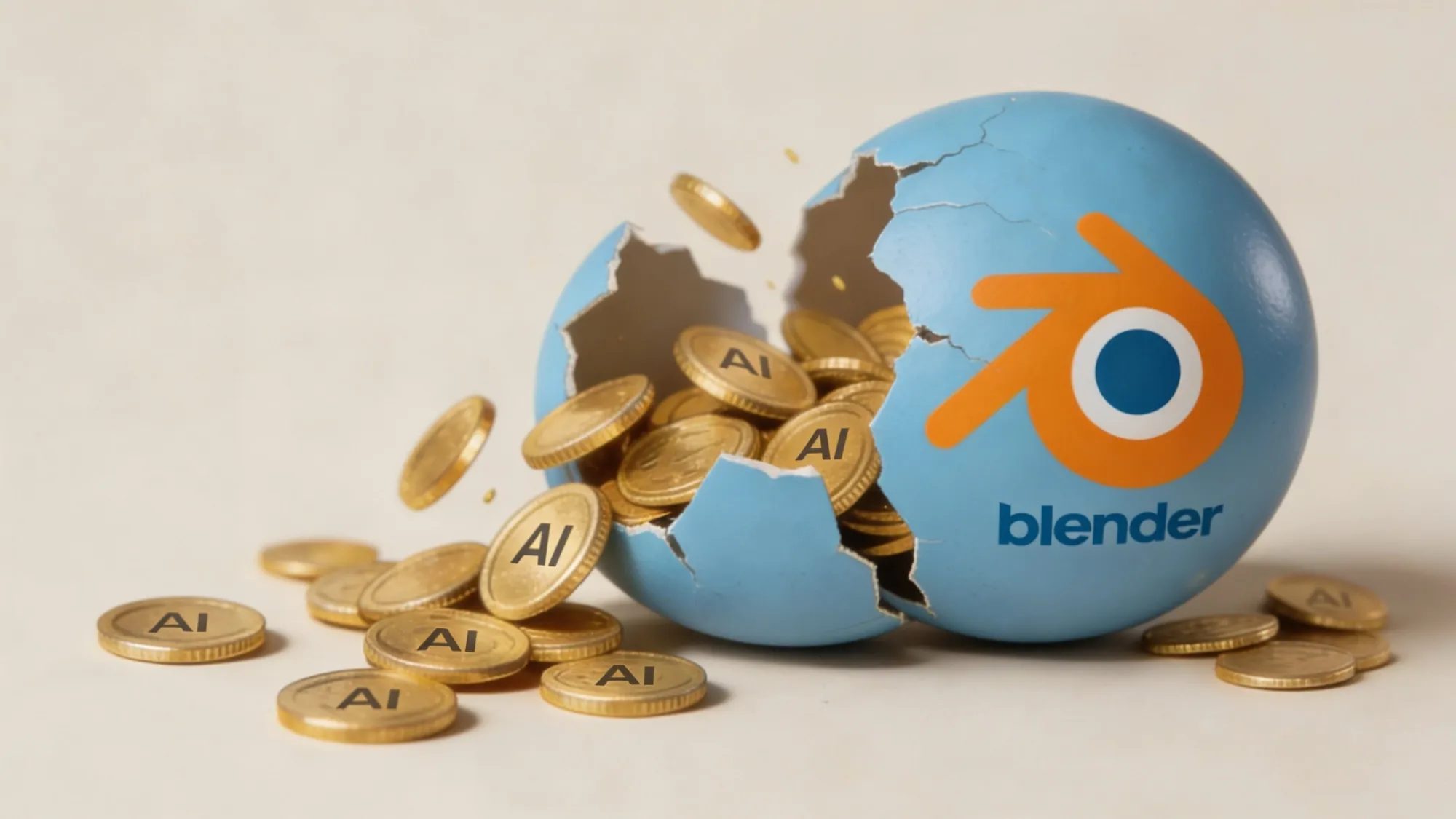
The Blender Foundation announced on April 28th that Anthropic had joined their Development Fund as a Corporate Patron. With that, Anthropic would contribute 240,000€ per year, going toward core Blender development. No feature mandate, no strings, the same structure as every other corporate sponsor, from Epic to Adobe to Meta.
The "community" lost its mind.
Three days later, the backlash forced the Blender Foundation to fold. Anthropic's ongoing sponsorship became a one-time donation. The Foundation apologized for not consulting the community first. They promised to "strengthen processes" around future donations and to "clearly define" Blender's position on generative AI. Francesco Siddi, the Foundation's Chairman & CEO (that succeeded Blender's creator Ton Rosendaal), had to go on record saying: "This is not an AI takeover."
I spent more than fifteen years working in architectural visualization. Blender was part of that world for more than half of that time. I know this community, and I know this pattern.
The people who led this charge are not, for the most part, Blender's core contributors or its full-time developers. They are users, many of them vocal, some of them not even active users at all. And what they accomplished was the elimination of four programmer salaries worth of annual funding from an organization that was already struggling to keep the lights on.
Blender survives on donations. The Foundation asks individuals, studios, and businesses to contribute every year. It competes for attention and funding against Autodesk, SideFX, and Maxon, which have resources that dwarf anything in the open-source world. Their 2024 annual report showed a total income of 3.1 million euro, expenses rising, and cash reserves already below their own three-month target. They spent the previous year running a campaign called "Join the 2%" - because only around 2% of their user base donates anything at all.
They added a donation button to the installer. That is the context in which this funding was rejected. Turning down 240,000€ a year in recurring institutional funding, with no strings attached, is not a principled stand (especially when they've been practically begging for donations for the past year or so). It is a luxury the Foundation cannot afford and one the community did not earn the right to demand through outrage.
The argument against the sponsorship is that Anthropic is an AI company, and therefore the money is "dirty." But the funding went toward general development, the same bucket that pays for the render engines, the UI improvements, and the bug fixes that benefit every single person who opens Blender today. Siddi said it plainly: "No generative AI functionality is currently available or planned to be integrated in Blender."
The Claude-Blender MCP connector that launched alongside the announcement is a tool built by Blender Lab. It works with any LLM. It does not require Anthropic's involvement to exist.
None of that mattered.
What strikes me most about this story is the certainty. People who use Blender to make art decided that a free and open-source software foundation accepting money from an AI company was a moral emergency, one serious enough to destroy the funding relationship in public, on social media, across a few days of coordinated pressure.
Take Robert Rioux, known in the Blender community as Blender Bob. He has been working in the VFX industry since 1995, across prestigious studios in Hawaii, Los Angeles, London, Vancouver, and Montreal. He has credits on more than 60 feature films and series , including Ad Astra, Stranger Things, Pacific Rim 2, Ghost In The Shell, X-Men Apocalypse, Star Trek: Insurrection, and Armageddon, among others. He created and published 45 free add-ons to the Blender community, all built with ChatGPT (at the beginning) and most of them with Claude. He never hid that fact, and he was attacked anyway, by people who in many cases had never heard of him 24 hours before. I went through some of the comments on his posts and on Blender's own announcement. A significant part of the negative responses came from accounts with no connection to Blender or 3D art whatsoever. No portfolio, no tools, just profile after profile filled with the same anti-AI memes and talking points, repeated across every other profile and every thread. People whose entire online presence is organized around opposing artificial intelligence (or anything else that's trending at the moment) decided to show up to police a funding decision for software they do not use.
Then there is Andrew Price, better known as Blender Guru. If you use Blender today, there is a reasonable chance his donut tutorial is how you started. It became the de facto entry point for an entire generation of 3D artists. People who went on to build careers, studios, and tools of their own. His course The Architecture Academy had a direct effect on my own trajectory. I was working in architectural visualization, deep in 3ds Max, and that course was the thing that showed me Blender could deliver the same results without the expensive subscription. And I never looked back.
For the last couple years or so, Andrew has become an increasingly controversial figure in the Blender community, largely because of his outspoken defense of AI and emerging technologies. That controversy followed him into this episode and colored a lot of the hostility directed at him. Whatever people think of his views, the point he made here was correct: approximately 30% of Blender's Dev Fund already comes from companies actively developing AI tools and platforms. If those sponsors pulled out in solidarity with the backlash, the Foundation would lose 852,000€ per year and likely need to fire one in three developers. That number did not make it into the outrage. It rarely does.
The irony runs deeper. In November 2025, the Foundation launched Blender Lab: an experimental space for prototyping ideas that don't fit within the constraints of the main release cycle. Touch input, VR, advanced rendering, and yes, AI tools are all part of its scope. Ton Toosendaal had been advocating for something like it since 2018. The Foundation has been signaling for years that Blender needs to evolve with emerging technology to stay relevant. The community celebrating this outcome celebrated against the direction the Foundation's own leadership has been pointing for a long time.
I'm not neutral on AI. I use it daily, I write about it, I am building tools that rely on local AI models, in part because I share some of the privacy concerns people raise about cloud-based and proprietary systems. But there is a real difference between skepticism and the kind of reflexive rejection that burned this funding deal. Skepticism asks questions, it weighs tradeoffs, and it distinguishes between "Anthropic is training on scrapped data" and "Anthropic is giving money to Blender core development means AI will replace Blender artists."
The second claim is not an argument, it's a feeling masked as one.
Open-source software needs money. Period. It always has. The idealism that powers these communities does not pay developers, does not run servers, and does not keep a foundation operational for the next decade. The Blender Foundation has Meta, Google, Adobe, and Nvidia as corporate sponsors. All four are among the most aggressive data-harvesting companies on the planet. Meta built its advertising empire on tracking every click and scroll of its billions of users. Google's entire business model is surveillance repackaged as free services. Adobe moved its tools to a subscription cloud and fought for years to own perpetual licenses to user-created content. Nvidia is one of the primary infrastructure providers for the AI systems the backlash claims to oppose. None of that triggered a campaign. None of that prompted demands for policy reviews or public apologies. Anthropic, offering unconditional funding for core development, became the line in the sand. During the same week, Meshy AI, a smaller corporate sponsor, was quietly removed from the sponsor page. Google and Nvidia stayed. Almost nobody noticed.
Blender will still receive the money as a one-time donation. The Foundation keeps its budget boost for this cycle, but the ongoing relationship is gone, and future AI companies watching this episode will think twice before offering support to open-source projects with vocal anti-AI factions. That cost is invisible right now, but it will not stay invisible forever. This will affect Blender in the long run, but also other open-source projects.
Robert Rioux ended one of his posts last week with something worth repeating: "I'm a CG artist. I do my modeling, I do my textures, I do my VFX. Claude just helps me be more efficient."
That is not a confession. It is a description of an artist's and professional's workflow from someone with thirty years of industry experience, who knew how to adapt to current times.
May The Code Be With You! 🚀
PS: And yes, the featured image was made with AI. Deal with it 😉