The AI That Stays at Home

Most of us who lean on AI now pay a monthly fee for it, and we hand over every question we ask without giving much thought to where it goes. Those words do go somewhere. They travel to a company's servers, get processed there, and in many cases stay on to help train the next version of the model. You can opt out of training in the settings, but how strictly companies actually honor that choice is hard to know for certain.
For most people the trade feels invisible, because the tool is useful, the fee is small, and the only cost on the other side is a faint sense that your conversations aren't fully your own.
There has always been another way to do this, at least on paper. Rather than renting access to a model that lives in some distant data center, you can run one directly on your own computer, where nothing you type ever leaves the room. The problem is that this has long been the territory of people who are comfortable in a terminal and willing to lose an afternoon (or more) working out which model their machine can handle, and that afternoon is where most curious people give up.
This is the backdrop against which Felix Kjellberg, the man a generation of the internet grew up watching as PewDiePie, released something at the end of May that he introduced, with a straight face, as his trillion dollar project. It is called Odysseus, and it gives you the familiar comfort of a ChatGPT-style window while running under your own control. He spent roughly a year building it out in the open, posting the whole untidy process to YouTube, and when he finally released it, the project gathered more than 30.000 GitHub stars within two days. It has since climbed past 76.000, a level of attention most funded companies never reach.
What sits inside is more than a place to chat. There is an assistant that can take on a whole task for you, reading your files, searching the web, and carrying out the steps on its own.
There is a research mode that works through many sources and writes them up into a single tidy report, a way to put two models side by side and judge their answers without knowing which is which, and the ordinary furniture of a working day, from documents to email to a calendar. All of it runs on your machine, and all of it is yours to keep, change, or share, because the software is released openly rather than locked behind a company's terms.
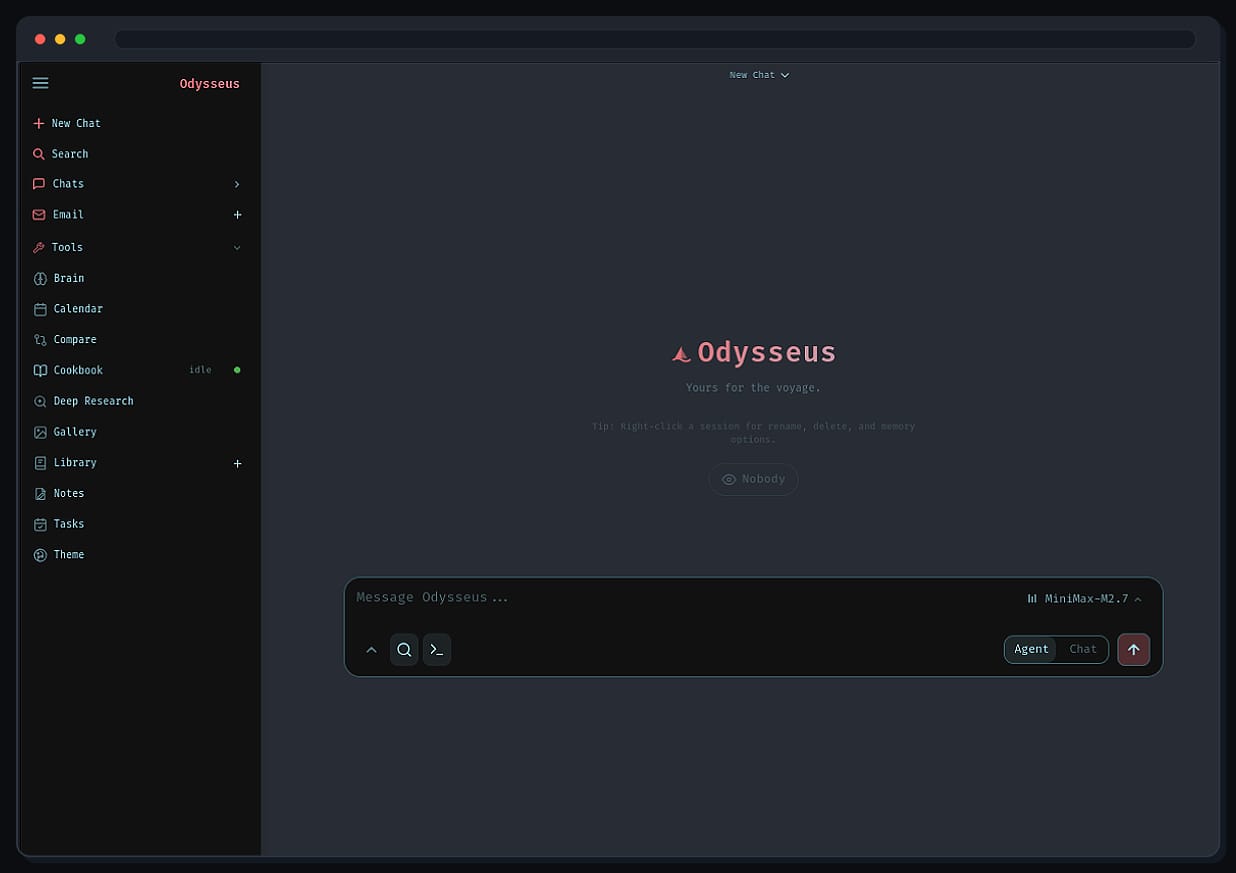
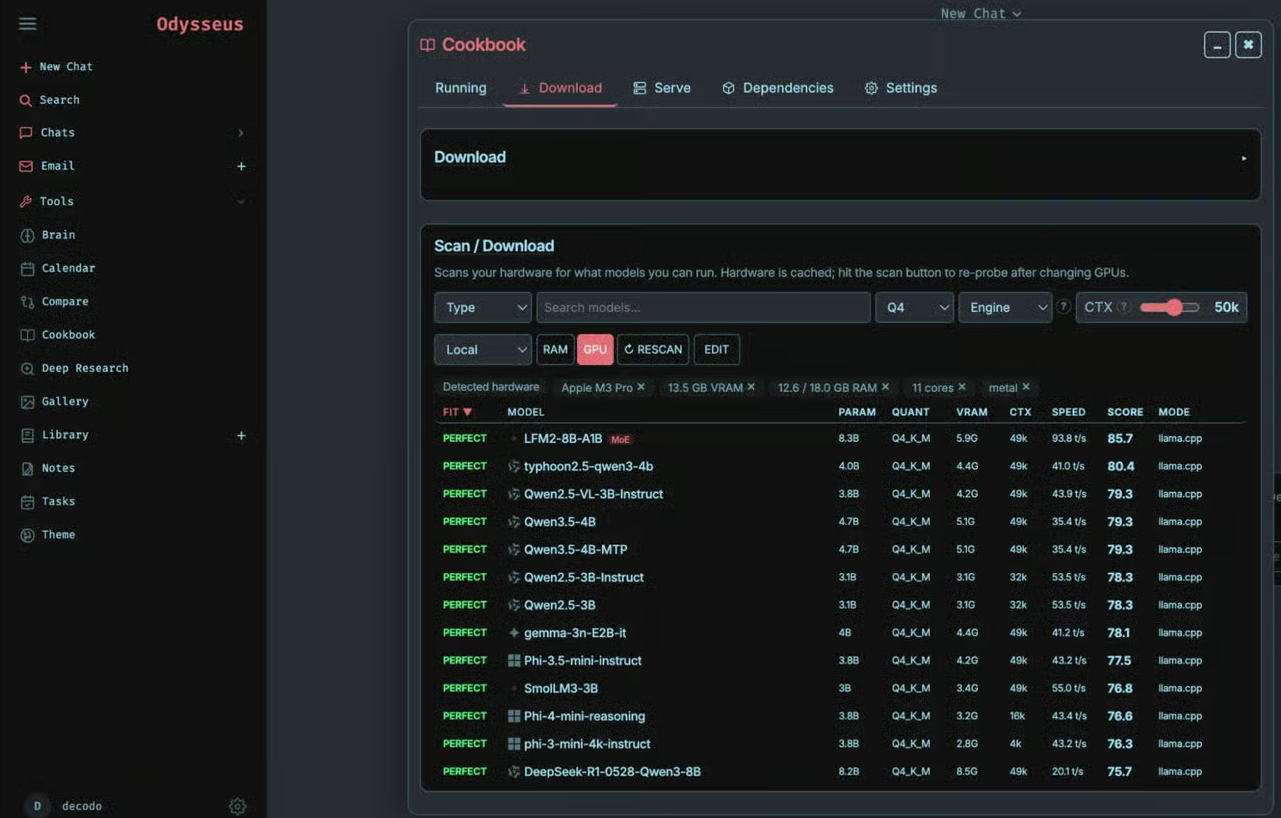
The feature that matters most, and the one that solves the afternoon problem I mentioned, is the part Kjellberg calls the Cookbook.
Running AI on your own computer comes down to one simple but awkward question: is your machine strong enough, and if so, which version of which model should you pick?
There are hundreds of them, in a bewildering spread of sizes and formats, and the old way to find out whether one would run was to download several gigabytes, try it, watch it choke, and begin again with something smaller. The Cookbook does away with that. It looks at your computer, works out how much room your graphics card has to spare, and scores how well each model would fit, the way a good shop assistant sizes you up before steering you toward the rack that will suit you. Then it downloads the one you choose and sets it running, in a couple of clicks, with none of the usual command-line wrestling. More than 270 models sit in that catalogue, each already measured against your hardware.
A few honest qualifications are worth stating, since the excitement around the launch tends to skip them:
- The privacy only holds while the model is running on your own machine. The moment you connect Odysseus to a paid service from one of the big companies, for the days when you want more power than your computer can give, your words travel out to their servers again like anyone else's.
- Running your own software is also never quite as effortless as installing an app, so some patience is part of the bargain. Kjellberg seems aware of this. At one point during the launch he admited, "I hate everything about this project", which is the sort of remark only someone who has built and maintained the thing would make.
What stays with me is the direction it gestures toward. For years the assumption has been that good AI must be rented from a handful of large companies, with your data quietly folded into the price. Odysseus is a serious and friendly argument that it does not have to work that way, and the Cookbook is the piece that brings that argument within the reach of someone who has never opened a terminal in their life.
It also arrives at a moment when the ground beneath it is shifting fast. A year ago the free models you could run yourself were mostly useful for light tasks. Anything that required real reasoning or sustained coding usually exposed their limits quickly.
The gap has narrowed noticeably. Some of the strongest open models now come from Chinese labs. In June, Zhipu AI released GLM-5.1, which independent benchmarks placed among the top open models available. On many demanding tasks it sits much closer to the best closed systems that open models did even a year earlier. The limitation is practical rather than intellectural: models at this level are still enormous and generally require a high-end machine or small server to run comfortably.
The more interesting movement is happening at the smaller end of the scale. Google's Gemma 4, released in the spring, includes versions small enough to run well on ordinary laptops, with one variant that even works on phones. These smaller models now handle reasoning and coding work that would have needed significantly more hardware not long ago. The same pattern appears in Meta's Llama series and several other releases. Each new wave extracts better performance from the same modest hardware.
Taken together, the direction is fairly clear. The strongest open models are improving from above, while smaller, runn able models are improving from below. The model that can run on your own machine still doesn't match the very best subscription options on the hardest tasks, but the distance has shrunk enough that the question "is the local version good enough for most of what I actually do?" is becoming reasonable to ask. Odysseus is built for exactly that moment. The Cookbook is the part that makes it accessible to someone who has no interest in spending an afternoon figuring out quantization and VRAM requirements.
That closing gap, more than any single tool, is what makes projects like this worth watching.
May The Code Be With You! 🚀