Skiff For Nothing

Most of the time, when a larger company buys a privacy-focused tool, the distinctive parts are the first things to go. The encryption model gets simplified, the independent infrastructure disappears, and what remains (if anything) is a thinner version that fits the acquirer's existing stack. The users who cared about the original product are left exporting data and looking for the next imperfect substitute. It has happened often enough that the cycle itself has become predictable.
Skiff was a clean example of that pattern.
Skiff was founded on April Fool's Day in 2020 by Andrew Milich and Jason Ginsberg, both Stanford graduates. Milich had interned at SpaceX on the Dragon 2 displays and worked on security-focused software. Ginsberg had worked on communication products at Apple. They met while organizing a Stanford hackathon years earlier and decided to build a full productivity suite that actually kept its promises about encryption. The first product was an end-to-end encrypted document editor, a deliberate alternative to Google Docs. By November 2021, anyone could sign up. Mail launched publicly on 17 May 2022, followed by Drive in June and Calendar in December of the same year.
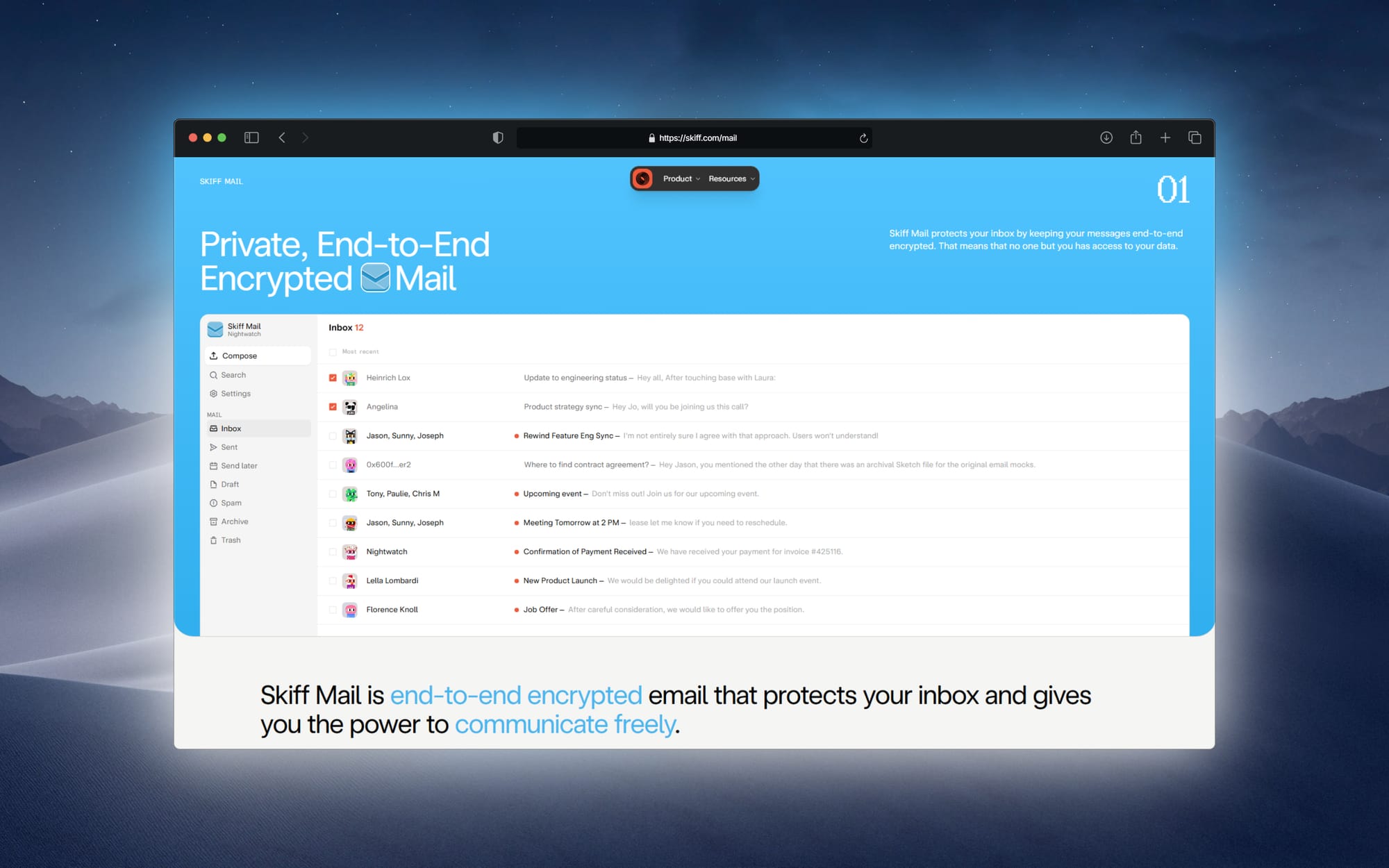
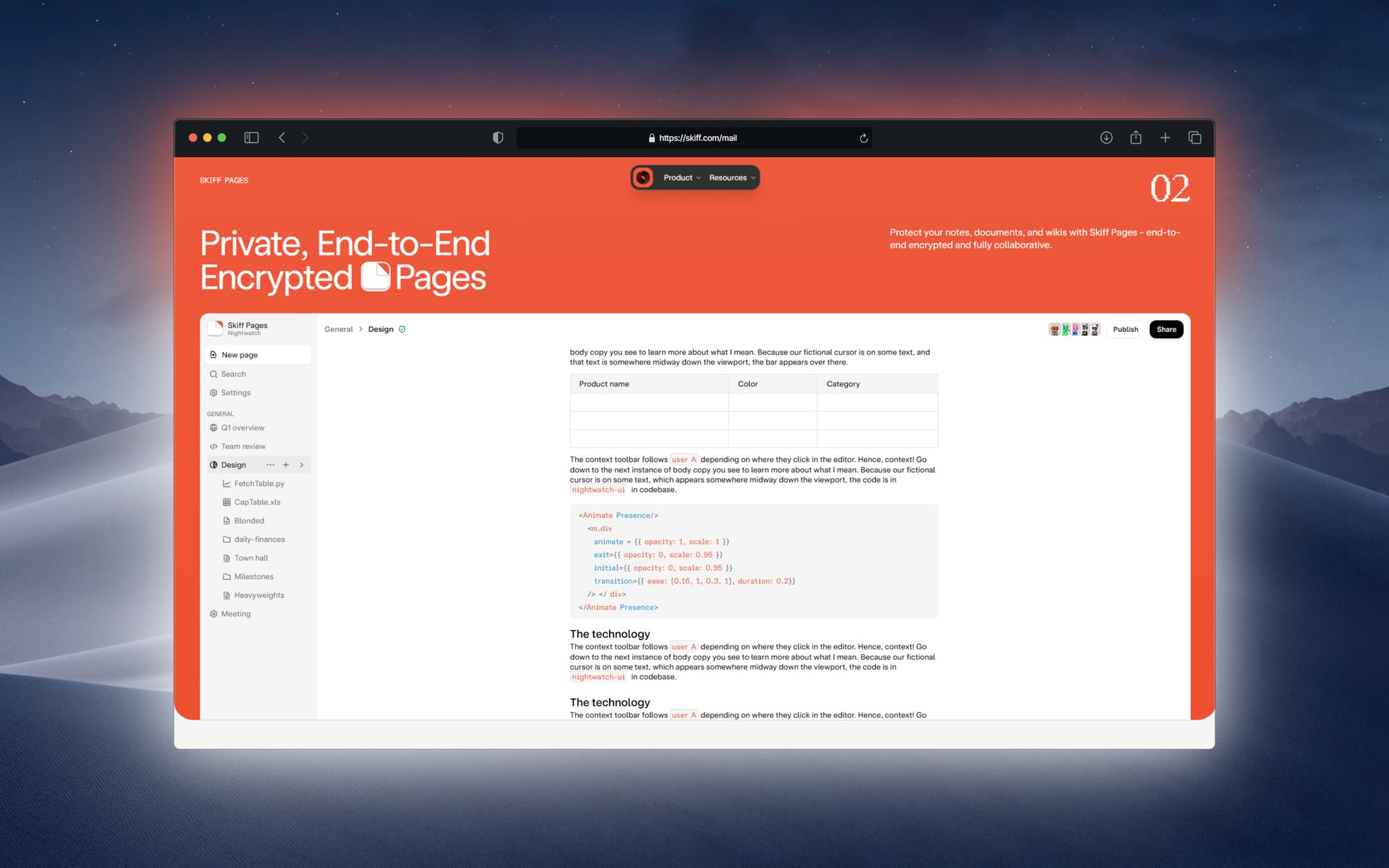
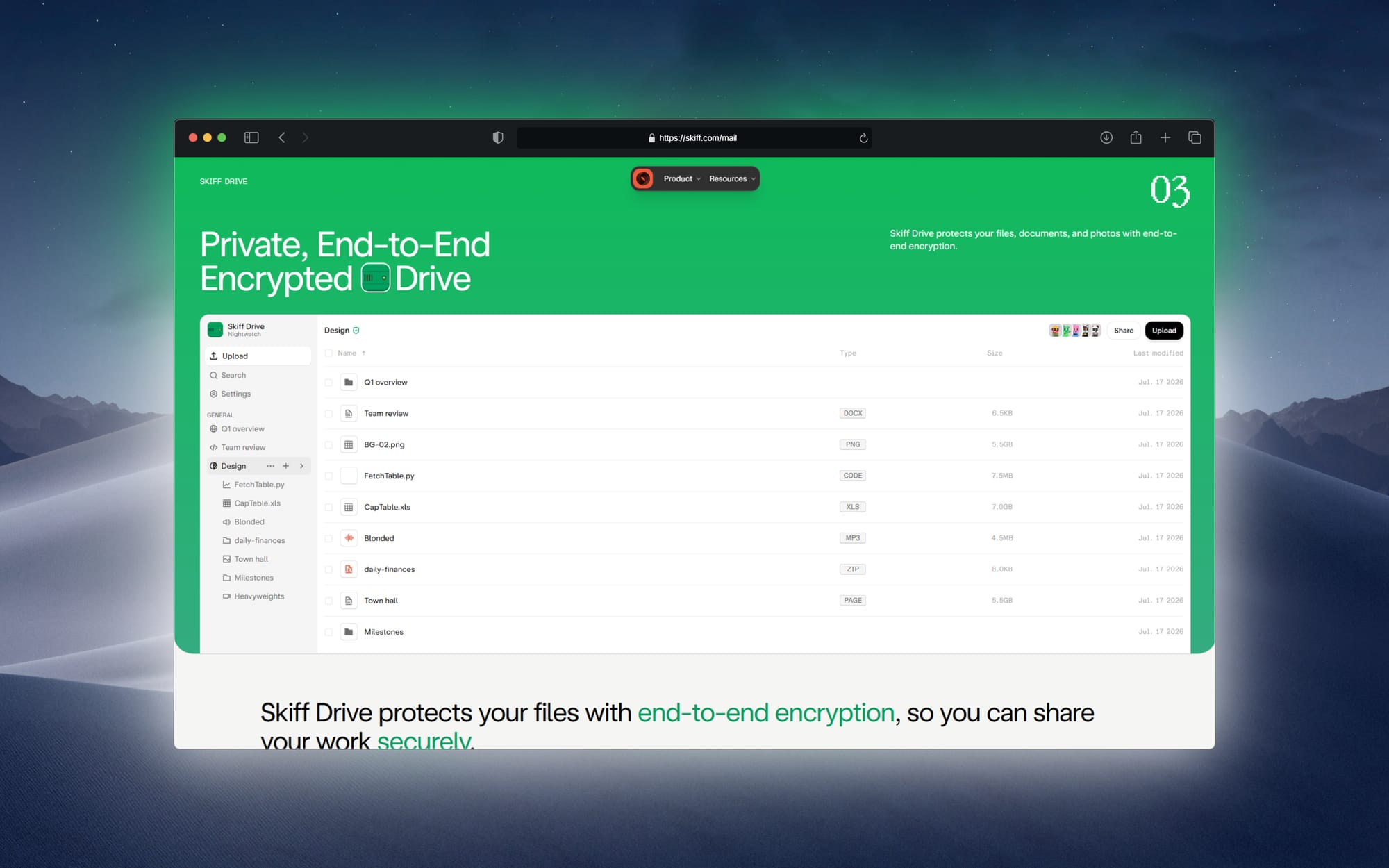
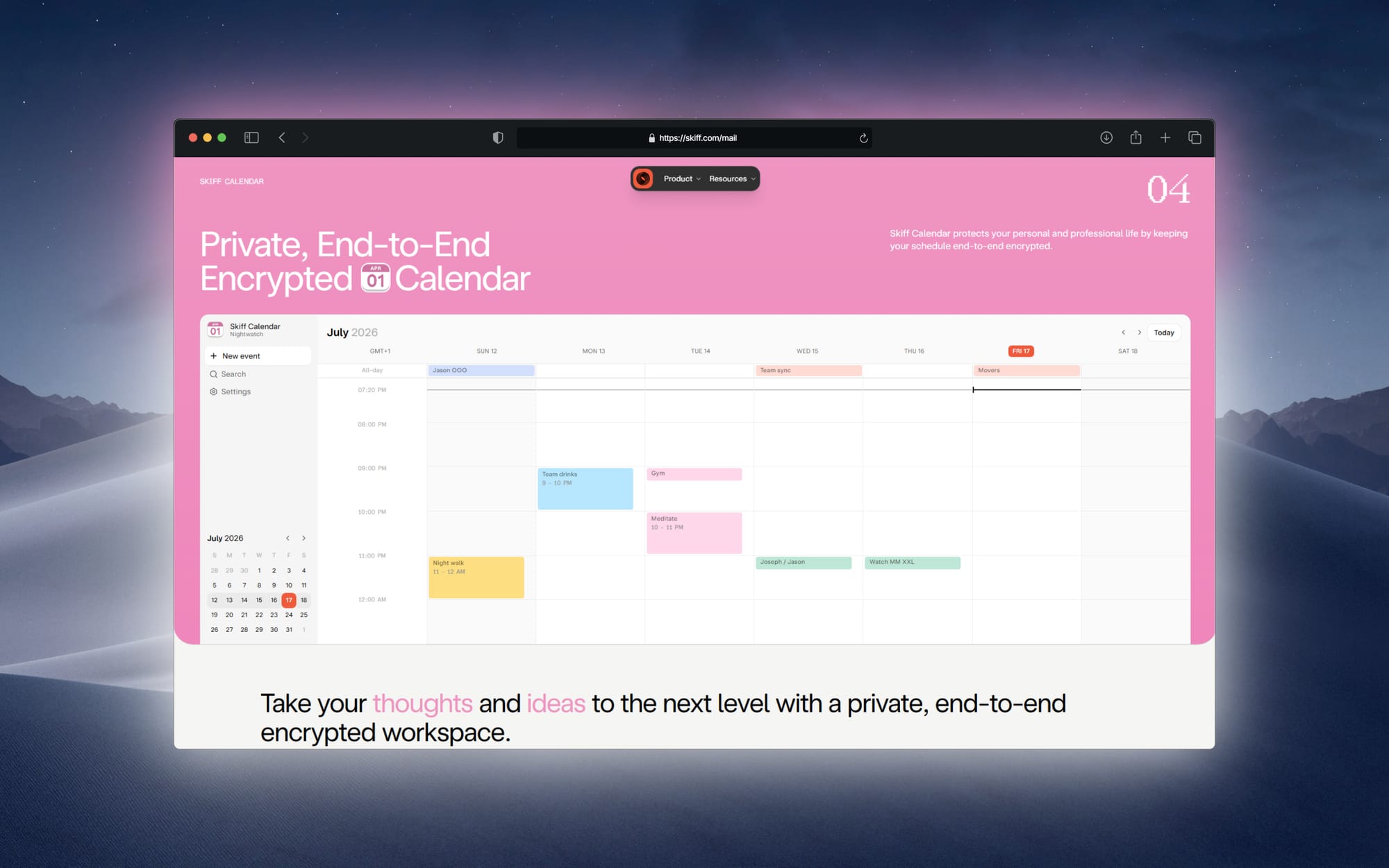
Everything sat on the same foundation: Encryption happened on the client before data ever left the device, and private keys never left the machine. Even Skiff's own servers could not read the contents of your messages, documents, files, or calendar events. Subjects of emails, titles of documents, event locations, and file names were encrypted along with the content itself. External mail was encrypted with the user's keys as soon as it arrived. They published a detailed whitepaper, went through multiple independent security audits, open-sourced parts of the cryptographic stack, and offered opt-in IPFS storage for files that needed to be more censorship-resistant. No ads, no tracking of logins or device identifiers. Unlimited aliases and custom domains were available so you could keep your identity cleaner.
You could even pay in crypto if you wanted the account itself to stay anonymous. Free accounts came with 10 GB of storage shared across the suite. By late 2023 it had reached roughly two million users.
What made it so good was the combination of seriousness and calm. The encryption was there, it wasn't just "marketing language." The interface was minimal and clean, with only the things you really needed.
Mail between Skiff users was fully end-to-end encrypted by default. Calendar events, including those with external attendees, stayed encrypted. Pages supported real-time collaboration without breaking the encryption model. Drive let you store and share files under the same zero-knowledge rules. It really was a complete privacy-first alternative to the Google suite instead of a single-purpose privacy app that forced you to keep ten other accounts running. I used it for my personal and work mail and files for a few months, and honestly, if it hadn't been shut down, I'd probably still be using it today instead of Proton.
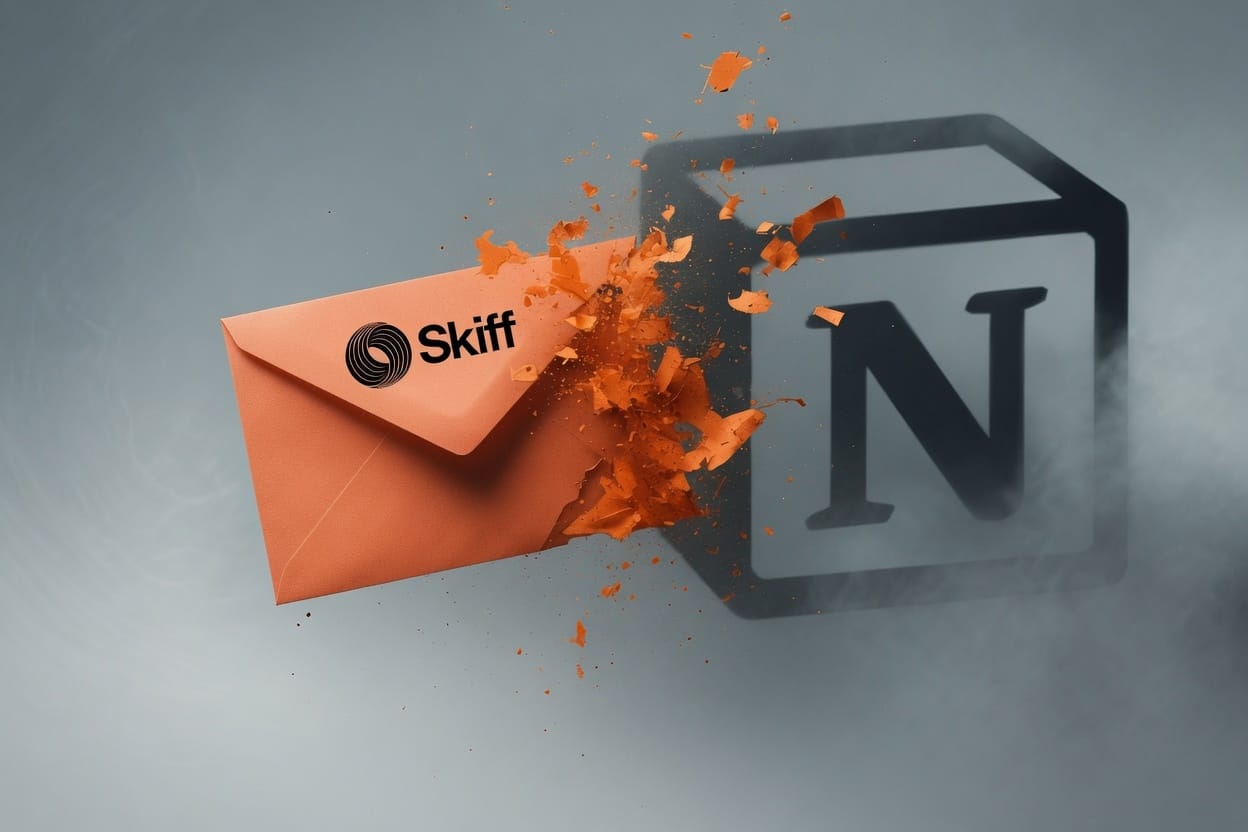
On 9 February 2024, Notion announced it had acquired Skiff.
The typical and familiar use of language like "joining forces," "shared mission," and "accelerating the work." For a short period, the products kept running while users were told to export their contents. Six months later everything was gone. Services shut down on 9 August 2024, and email forwarding continued until 9 February 2025 for people who had set it up in time. The @skiff.com addresses disappeared, and the users exported what they could and left. Nothing was migrated into Notion, the independent privacy-first product simply ended.
Milich and Ginsberg stayed on and helped build what became Notion Mail. It reached general availability in April 2025. On paper it looked like a natural continuation, but in practice it was nothing more than an overhyped (like everything in Notion) and glorified Gmail wrapper, a Notion-branded skin sitting on top of Google's infrastructure. It had AI labeling, custom views, and scheduling features, but none of the encryption model that had defined Skiff. It was not a real email client or even a serious mail alternative. It was a polished front-end for an inbox that still lived at Google. I tried it for a while, and the difference was obvious. The calm, self-contained quality was gone. And the bugs, don't even get me started. I couldn't use it for more than a week.
Milich and Ginsberg later left Notion and joined Cursor as key engineering leaders. Milich served as Head of Engineering and Ginsberg as Head of Product Engineering. In March 2026, both moved to xAI and SpaceX to strengthen the companies' internal AI and coding capabilities. Not long after their departure, SpaceX acquired Anysphere, the company behind Cursor, in an all-stock deal. By then, the original product, Skiff, had already been gone for well over a year.
On 25 June 2026, Notion announced that the Notion Mail inbox itself is winding down across web, desktop, and iOS on 22 September 2026. The stated reason is that more than half of its users already manage email through Notion's AI agents without opening the inbox, so the company is going all-in on agents. The underlying Gmail messages stay where they are, but the Notion-specific pieces (drafts, scheduled sends, snippets, auto-label rules, etc.) need to be exported before the date or they vanish.
The original product is gone, and the thinner successor is being retired. Parts of Skiff's code remain open-source on GitHub, which in theory leaves the door open for someone to revive or fork the project. In practice it seems unlikely. The founders are now deep inside SpaceX and xAI, working on problems of a completely different scale. The people who built the original thing have moved on, and the company that acquired it never really intended to use or keep it.
This is how most of the better privacy-first tools disappear. Someone builds something that actually works with real encryption and no advertising incentives. It gains a user base that cares about the product; a big tech company buys it, usually with warm language about alignment. The distinctive parts get stripped because they do not fit the new owner's model (especially their revenue model). The original product is shut down on a fixed timeline; a thinner version may appear for a year or two. Then that version is also retired when the next strategic priority arrives. The users who valued the original thing are left exporting data and looking for the next imperfect substitute.
Skiff was a better product than Notion Mail ever was, and it disappeared for nothing.
May The Code Be With You! 🚀