
Between You and the Tool
I was right in the middle of something. Not deep into building anything yet, but in the messy early stage. Dumping ideas onto paper and trying to picture how a small app I've had in my head for a while might use a local AI to connect those notes and thoughts.
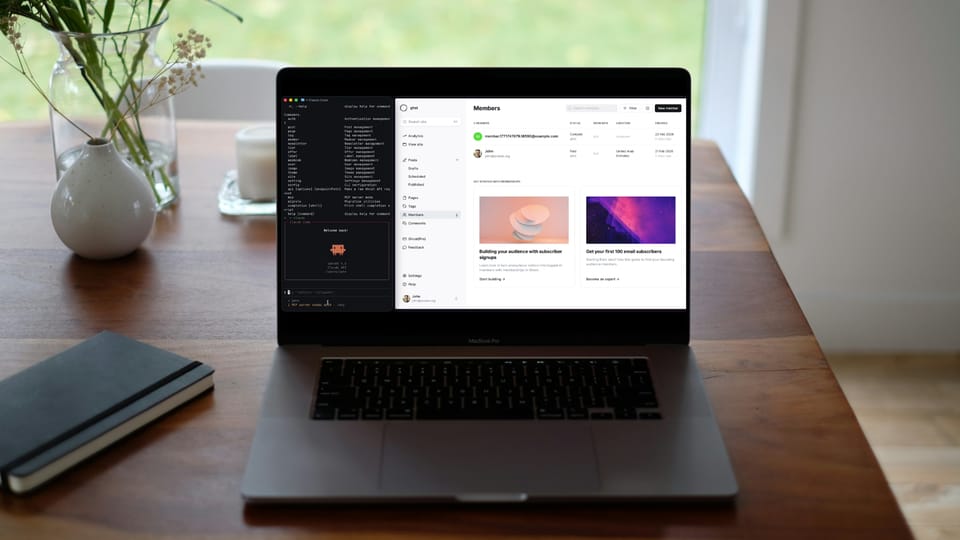
Then it just popped up in my X feed: John O'Nolan made an X post about something he developed. He built a CLI tool for Ghost, called ghst, that basically wraps Ghost's entire Admin API. It gives a CLI and an MCP server so an AI agent can drive everything through plain language. With it you can install a theme you saw somewhere else, give a member a complimentary subscription, check the analytics of your posts, and most of the things that are spread across different screens in the Ghost admin. Now all that can be handled by describing it to the AI.
Recently, I've found my preferred way to interact with lots of products is getting Claude to use a CLI tool, and then just talking to it out loud about what I want to happen.
— John O'Nolan (@JohnONolan) March 20, 2026
So I made a CLI tool for @Ghost, to see what it would be like in our own product - it's called `ghst`… pic.twitter.com/8ba0Umv1fH
He didn't build it because it was on the roadmap. He made it to see if it was possible, used it for an hour, and then wrote a short, uncertain post about the experience. The uncertainty is precisely why it caught my attention.
After an hour using Claude through the CLI instead of the browser, he found it faster than clicking through the admin. That's the part I keep thinking about. Not the tool itself. Who said it, and what he noticed.
He kept the regular Ghost admin open the whole time. What changed was his relationship to it. The admin stopped being where the work happened and became the place where he checked to see if things looked right, to verify the output before moving on. The conversation with the AI made the work happen, and the UI became the review layer.
That pattern will feel familiar to anyone following the AI coding side of things. A year ago you were in the editor all day, writing all the code yourself. Now many developers describe their role differently: the agent writes the code, and they give the inputs and review the outputs. O'Nolan drew the same parallel, pointing to how tools built around agentic coding are designed specifically around that loop. The editor used to be where everything happened. Now it has become a review surface.
He's also careful not to oversell it. Most users won't need to know what a CLI or MCP server even is, and the whole pattern still has plenty of rough edges. He admits he doesn't have a firm conclusion yet, which I respect a lot more than confident predictions.
The timing caught me off guard because I'd been thinking about a version of the same problem but from a different angle. My focus has been on reducing the gap between scattered ideas and a finished piece of writing, and whether a local AI with access to my notes could help with that. O'Nolan's focus was on whether a CLI with access to Ghost Admin changed how he worked with the platform. The issues look different on the surface. The underlying question is the same: what changes when an AI sits between you and the tool?
I don't have an answer yet, I'm still at the brainstorming stage. But seeing the same question from the other angle helped.
If you want to test it, here are the beta details and setup: https://forum.ghost.org/t/developer-beta-ghst-cli/62228
The link to O'Nolan's post on his Ghost blog: https://john.onolan.org/i-built-a-cli-for-ghost/
And the video showing everything:
May The Code Be With You! 🚀




Member discussion